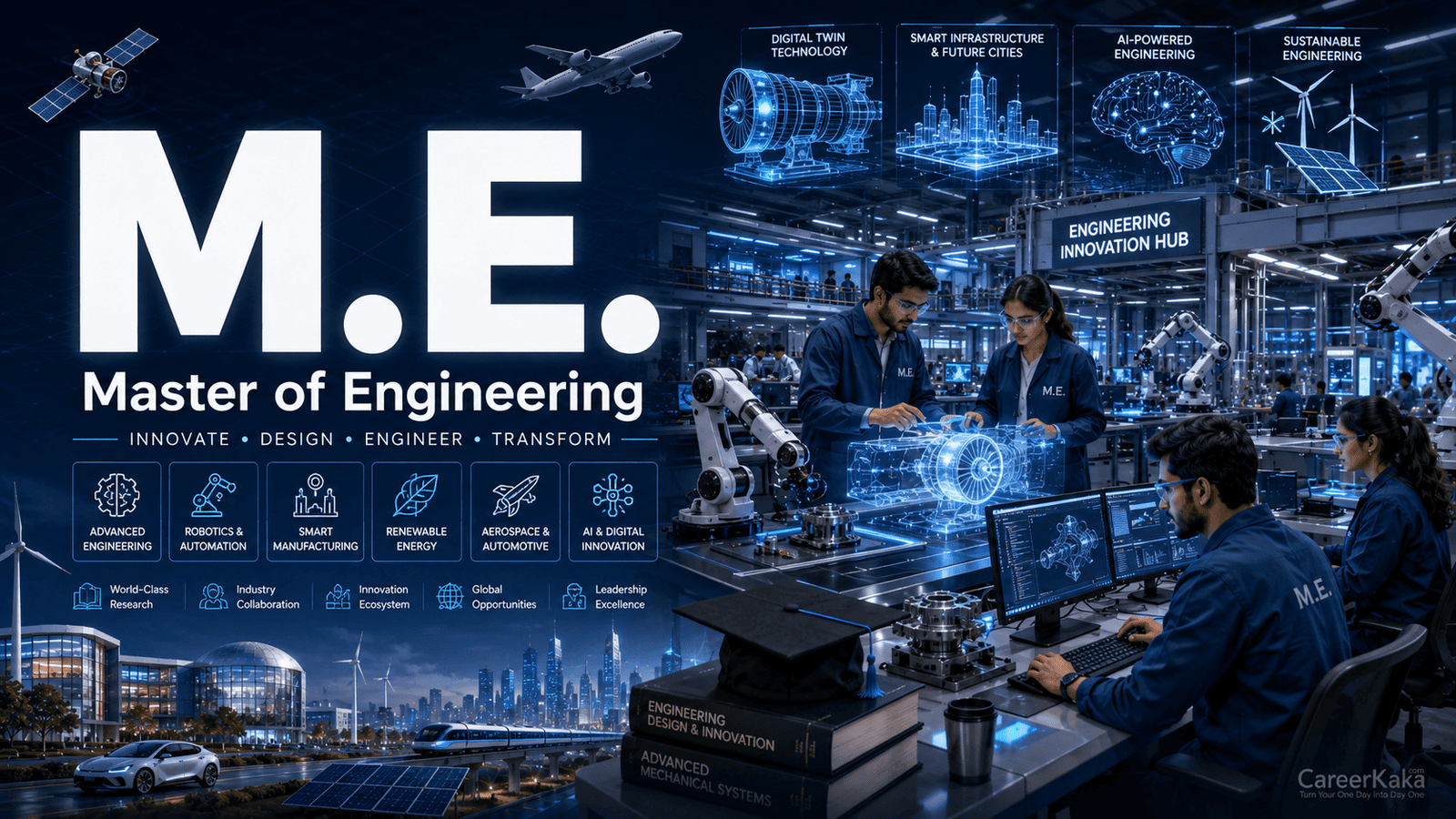
M. E
**Master of Engineering (M.E.) is a postgraduate engineering degree program that focuses on advanced technical education, professional expertise, and specialized knowledge in various engineering disciplines. The course is designed to enhance analytical, problem-solving, and practical skills through advanced coursework, projects, and industry-oriented training. Students can pursue specializations such as Mechanical Engineering, Civil Engineering, Electrical Engineering, Computer Engineering, Electronics, and more. Typically completed in 2 years, the program prepares graduates for technical leadership roles, engineering design, product development, research, consulting, and management positions across diverse industries and technology-driven organizations worldwide.
Course Eligibitlity
B.E/B.Tech in relevant engineering discipline with min. 55%; GATE score preferred
-
Course Duration:
2 Years
-
Avg Fee:
Depending on College, Location
-
Offering This Course:
0 Universities
Overview of M. E
M.E. (Master of Engineering)
Introduction
Master of Engineering (M.E.) is a postgraduate engineering degree program that focuses on advanced technical education and specialized knowledge in various engineering disciplines. The course is designed to enhance students' engineering expertise, analytical abilities, problem-solving skills, and professional competencies through advanced coursework, practical training, research activities, and industry-oriented projects. M.E. emphasizes the application of engineering principles to solve real-world challenges and develop innovative solutions. The program is ideal for engineering graduates seeking technical specialization, career advancement, leadership roles, or opportunities in research and development across diverse industries.
M.E. Course Highlights
| Particulars | Details |
|---|---|
| Course Name | Master of Engineering (M.E.) |
| Course Level | Postgraduate |
| Duration | 2 Years |
| Semester Pattern | 4 Semesters |
| Eligibility | B.E., B.Tech, or equivalent degree from a recognized institution |
| Admission Process | Entrance Exam-Based or Merit-Based |
| Course Mode | Full-Time, Part-Time |
| Average Starting Salary | ₹5 LPA – ₹12 LPA |
| Higher Education Options | Ph.D., Research Programs, Professional Certifications |
Why Choose M.E.?
An M.E. degree enables students to gain specialized knowledge and advanced technical skills in their chosen engineering field. The program helps graduates stay updated with emerging technologies, industry trends, and innovative engineering practices. It also improves career prospects by opening opportunities in research, product development, design engineering, consulting, project management, and academic careers. M.E. graduates are often preferred for senior technical and leadership positions in engineering organizations.
Eligibility Criteria
Candidates seeking admission to the M.E. program generally need to fulfill the following requirements:
- Bachelor's degree in Engineering or Technology (B.E./B.Tech) from a recognized university.
- Minimum qualifying marks as prescribed by the institution.
- Valid entrance examination scores may be required by some universities.
- Additional eligibility requirements may vary depending on the specialization and institution.
Admission Process
Admission to M.E. programs is generally offered through:
Entrance Exam-Based Admission
Qualification in national-level, state-level, or university-level entrance examinations.
Merit ranking and counseling process.
Seat allocation based on eligibility and entrance scores.
Merit-Based Admission
Selection based on academic performance in the qualifying degree.
Counseling and document verification.
Popular M.E. Specializations
Students can pursue M.E. in various engineering disciplines, including:
- M.E. Computer Engineering
- M.E. Mechanical Engineering
- M.E. Civil Engineering
- M.E. Electrical Engineering
- M.E. Electronics and Communication Engineering
- M.E. Information Technology
- M.E. Structural Engineering
- M.E. Power Systems Engineering
- M.E. Robotics Engineering
- M.E. Artificial Intelligence
- M.E. Data Science
- M.E. VLSI Design
- M.E. Environmental Engineering
- M.E. Aerospace Engineering
- M.E. Industrial Engineering
- M.E. Manufacturing Engineering
- M.E. Automobile Engineering
- M.E. Cyber Security
Skills Developed During M.E.
The program helps students acquire advanced technical and managerial skills such as:
- Advanced Engineering Knowledge
- Research and Development Skills
- Critical Thinking
- Analytical Ability
- Problem-Solving Skills
- Technical Design and Innovation
- Project Management
- Leadership and Teamwork
- Technical Communication
- Industry-Specific Expertise
Career Opportunities After M.E.
M.E. graduates have excellent career opportunities across engineering, manufacturing, construction, information technology, research, and consulting sectors.
Popular Job Profiles
- Design Engineer
- Project Engineer
- Research Engineer
- Systems Engineer
- Structural Engineer
- Software Engineer
- Data Engineer
- Automation Engineer
- Product Development Engineer
- Technical Consultant
- Quality Assurance Engineer
- Engineering Manager
- Production Manager
- Lecturer or Professor
- R&D Specialist
Top Recruiters
M.E. graduates are recruited by leading engineering, technology, manufacturing, and research organizations, including:
- Tata Consultancy Services
- Infosys
- Wipro
- HCLTech
- Accenture
- Siemens
- Bosch
- Larsen & Toubro
- Intel
- IBM
Salary After M.E.
Salary packages depend on specialization, industry, technical skills, and work experience.
| Experience Level | Average Salary |
|---|---|
| Freshers | ₹5 LPA – ₹12 LPA |
| Mid-Level Professionals | ₹10 LPA – ₹20 LPA |
| Experienced Professionals | ₹20 LPA+ |
Specializations such as Artificial Intelligence, Data Science, Robotics, VLSI Design, and Cyber Security often offer higher salary potential.
Higher Education Options
After completing M.E., graduates can pursue:
- Ph.D.
- Research Fellowships
- Postdoctoral Research
- Professional Certifications
- Industry-Specific Advanced Programs
- International Research Opportunities
Frequently Asked Questions (FAQs)
Is M.E. a good career option?
Yes, M.E. is an excellent choice for engineering graduates who want advanced technical expertise, specialization, and better career opportunities.
What is the duration of the M.E. course?
The M.E. program generally has a duration of 2 years and is divided into 4 semesters.
Can I pursue a Ph.D. after M.E.?
Yes, M.E. provides a strong academic foundation for doctoral and research programs.
Which M.E. specialization offers the best career prospects?
Artificial Intelligence, Data Science, Robotics, Cyber Security, Computer Engineering, and VLSI Design currently offer strong career opportunities.
What is the difference between M.E. and M.Tech?
M.E. is generally considered more application and coursework-oriented, while M.Tech often emphasizes technical research and innovation. However, both degrees are widely recognized and offer similar career opportunities.
Can M.E. graduates work in research and development?
Yes, M.E. graduates are highly sought after in research laboratories, engineering organizations, and technology companies involved in innovation and product development.
No universities found for this course.