BITSAT
BITSAT
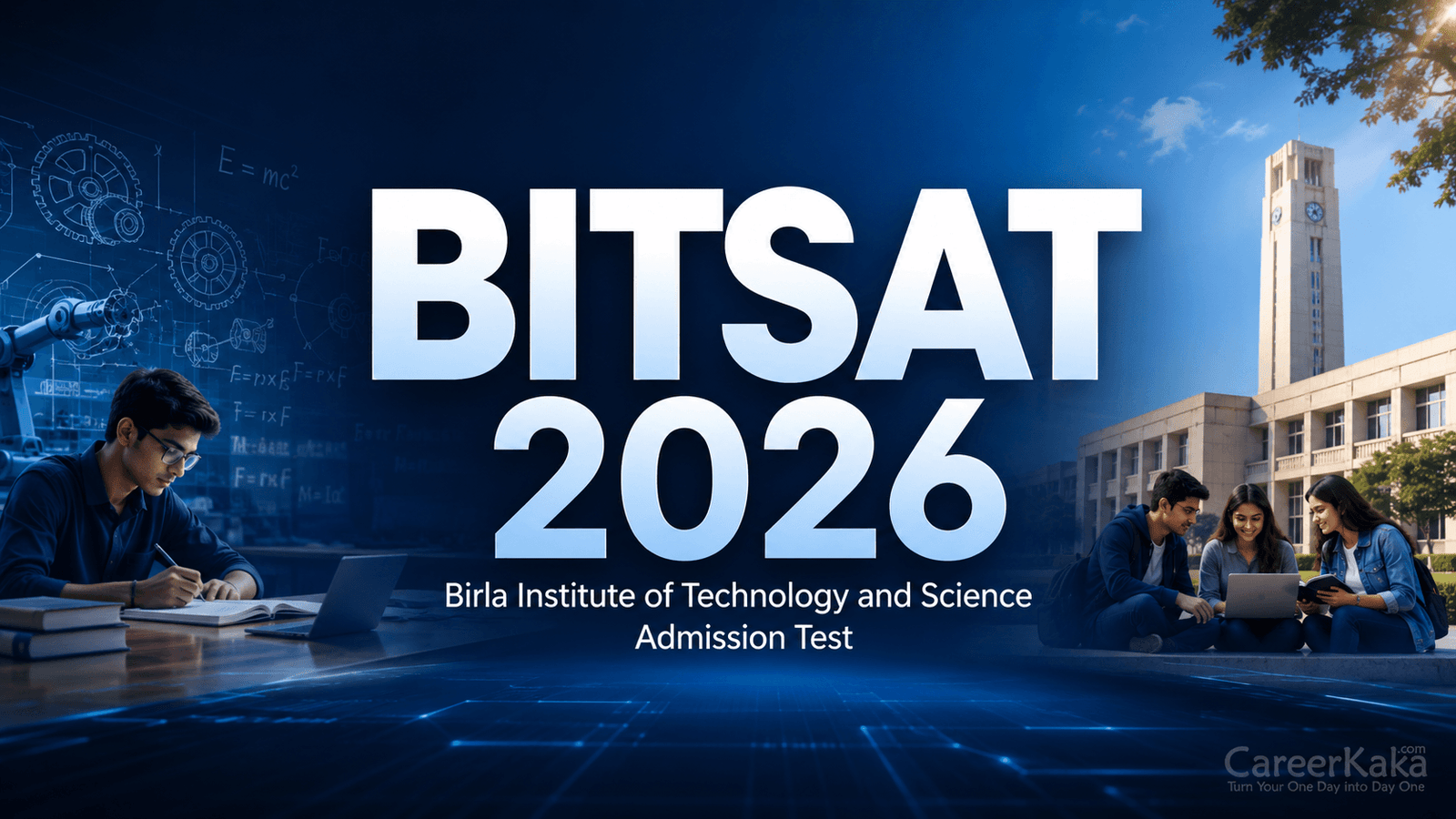
BITSAT (Birla Institute of Technology and Science Admission Test) is a university-level entrance examination conducted by BITS Pilani for admission to integrated first-degree programs offered at its Pilani, Goa, and Hyderabad campuses. The exam assesses students in Physics, Chemistry, Mathematics/Biology, English Proficiency, and Logical Reasoning. BITSAT is known for its flexible admission process, modern campuses, and strong placement opportunities. Students seeking admission to one of India's leading private engineering institutions consider BITSAT an important alternative to JEE Main and JEE Advanced.
BITSAT 2026
Birla Institute of Technology and Science Admission Test (BITSAT)
About BITSAT 2026
BITSAT (Birla Institute of Technology and Science Admission Test) is a university-level engineering entrance examination conducted by the Birla Institute of Technology and Science (BITS), Pilani for admission to Integrated First Degree programs offered at its Pilani, Goa, and Hyderabad campuses. BITSAT is one of India's most prestigious private engineering entrance examinations and is known for its highly competitive admission process, flexible academic structure, and excellent placement opportunities.
Key Highlights
- University-level entrance examination.
- Conducted by BITS Pilani.
- Admission to B.E., B.Pharm., and M.Sc. programs.
- Computer-Based Test (CBT).
- Conducted in two sessions.
- Fully objective-type examination.
- Instant score display after exam completion.
- Direct admission available for board toppers under specific criteria.
Eligibility Criteria
Candidates must fulfill the following requirements:
- Must have passed Class 12 (10+2) examination from a recognized board.
- Physics, Chemistry, and Mathematics are mandatory for B.E. programs.
- Physics, Chemistry, and Biology/Mathematics are required for B.Pharm.
- Minimum 75% aggregate marks in Physics, Chemistry, and Mathematics/Biology.
- Minimum 60% marks individually in Physics, Chemistry, and Mathematics/Biology.
- Candidates appearing in Class 12 examination in 2026 are also eligible.
- Only students passing Class 12 in 2025 or 2026 are generally eligible.
Educational Qualification
| Requirement | Details |
|---|---|
| Qualification | Class 12 (10+2) |
| Mandatory Subjects | Physics, Chemistry & Mathematics |
| Minimum Aggregate Marks | 75% in PCM |
| Minimum Individual Marks | 60% in each subject |
| Appearing Candidates | Eligible |
Exam Pattern
| Particulars | Details |
|---|---|
| Exam Name | BITSAT 2026 |
| Conducting Authority | BITS Pilani |
| Mode of Examination | Computer-Based Test (CBT) |
| Duration | 3 Hours |
| Total Questions | 130 |
| Total Marks | 390 |
| Question Type | Multiple Choice Questions (MCQs) |
| Correct Answer | +3 Marks |
| Incorrect Answer | -1 Mark |
| Language | English |
Subject-wise Distribution
| Subject | Questions | Marks |
|---|---|---|
| Physics | 30 | 90 |
| Chemistry | 30 | 90 |
| English Proficiency | 10 | 30 |
| Logical Reasoning | 20 | 60 |
| Mathematics / Biology | 40 | 120 |
| Total | 130 | 390 |
Bonus Questions Feature
| Particulars | Details |
|---|---|
| Bonus Questions | 12 Additional Questions |
| Eligibility | After attempting all 130 Questions |
| Maximum Score | 426 Marks |
BITSAT 2026 Syllabus
Physics
| Unit | Topics Covered |
|---|---|
| Units & Measurements | Physical Quantities, Errors |
| Mechanics | Laws of Motion, Work Energy Power |
| Rotational Motion | Centre of Mass, Angular Momentum |
| Gravitation | Universal Gravitation |
| Properties of Matter | Elasticity, Fluid Mechanics |
| Heat & Thermodynamics | Thermal Properties, Thermodynamics |
| Oscillations & Waves | SHM, Wave Motion |
| Electrostatics | Charges, Electric Fields |
| Current Electricity | Current, Resistance, Circuits |
| Magnetism | Magnetic Effects of Current |
| Electromagnetic Induction | EMI & Alternating Current |
| Optics | Reflection, Refraction, Optical Instruments |
| Modern Physics | Atoms, Nuclei, Semiconductors |
Chemistry
| Unit | Topics Covered |
|---|---|
| Atomic Structure | Quantum Theory, Atomic Models |
| Chemical Bonding | Molecular Structure |
| States of Matter | Gases and Liquids |
| Thermodynamics | Enthalpy, Entropy |
| Equilibrium | Chemical & Ionic Equilibrium |
| Electrochemistry | Electrochemical Cells |
| Chemical Kinetics | Rate of Reactions |
| Surface Chemistry | Adsorption, Catalysis |
| Organic Chemistry | Hydrocarbons, Alcohols, Phenols |
| Carbonyl Compounds | Aldehydes, Ketones, Carboxylic Acids |
| Biomolecules | Proteins, Carbohydrates |
| Polymers | Classification and Uses |
| Coordination Compounds | Bonding and Isomerism |
| p-Block & d-Block Elements | Properties and Reactions |
Mathematics
| Unit | Topics Covered |
|---|---|
| Algebra | Complex Numbers, Quadratic Equations |
| Matrices & Determinants | Matrix Operations |
| Sequence & Series | AP, GP, HP |
| Binomial Theorem | Expansion and Applications |
| Permutation & Combination | Counting Principles |
| Probability | Probability Distributions |
| Trigonometry | Trigonometric Functions |
| Differential Calculus | Limits, Continuity, Differentiation |
| Integral Calculus | Indefinite & Definite Integrals |
| Differential Equations | Basic Differential Equations |
| Coordinate Geometry | Straight Lines, Circles |
| Conic Sections | Parabola, Ellipse, Hyperbola |
| Vector Algebra | Vector Operations |
| Three-Dimensional Geometry | Lines and Planes |
English Proficiency
| Topics Covered |
|---|
| Grammar |
| Vocabulary |
| Synonyms & Antonyms |
| Sentence Completion |
| Reading Comprehension |
| Error Detection |
Logical Reasoning
| Topics Covered |
|---|
| Verbal Reasoning |
| Analytical Reasoning |
| Logical Deduction |
| Series & Patterns |
| Data Interpretation |
| Puzzle-Based Questions |
Important Dates (Tentative)
| Event | Expected Date |
|---|---|
| Application Form Release | January 2026 |
| Session 1 Registration Last Date | April 2026 |
| Session 1 Exam | May 2026 |
| Session 1 Result | May 2026 |
| Session 2 Registration Window | May 2026 |
| Session 2 Exam | June 2026 |
| Session 2 Result | June 2026 |
| Admission Application Form | June 2026 |
| Counselling & Seat Allotment | July–August 2026 |
Counselling Process
BITS Pilani conducts its own admission and seat allotment process based on BITSAT scores.
Counselling Procedure
- Registration for Admission
- Programme Preference Filling
- Merit List Preparation
- Iteration-wise Seat Allotment
- Fee Payment
- Document Verification
- Admission Confirmation
Documents Required
- BITSAT Score Card
- Class 10 Marksheet
- Class 12 Marksheet
- Transfer Certificate
- Migration Certificate
- Passport Size Photographs
- Category Documents (if applicable)
Participating Campuses
- BITS Pilani (Rajasthan)
- BITS Goa
- BITS Hyderabad
Frequently Asked Questions (FAQs)
1. What is BITSAT?
BITSAT is the entrance examination conducted by BITS Pilani for admission to B.E., B.Pharm., and M.Sc. programs across its campuses.
2. Is there negative marking in BITSAT?
Yes. Candidates receive +3 marks for every correct answer and -1 mark for every incorrect answer.
3. How many questions are asked in BITSAT?
BITSAT contains 130 questions, with an option to attempt 12 bonus questions after completing all regular questions.
4. Can students appear in both BITSAT sessions?
Yes. Candidates can appear in both sessions, and the higher score is considered for admission.
5. What is considered a good BITSAT score?
Generally, a score above 280–320+ is considered competitive for popular branches such as Computer Science, Electronics, and Mathematics at BITS Pilani, though cutoffs vary annually.
Official Website
- BITSAT Official Portal
- https://www.bitsadmission.com
- BITS Pilani Official Website
- https://www.bits-pilani.ac.in